
Delta County Parole vs Probation
Parole and probation are both forms of supervision, but they do not come from the same place. A person released from the Delta County Detention Facility may be placed on probation by the court, especially after a local sentence or a violation matter. A person released from Delta Correctional Center or another state prison may be on parole through CDOC and the Colorado State Board of Parole.
| Supervision Type | Who Controls It | Delta County Verification Path |
|---|---|---|
| Probation | Colorado Judicial Branch probation | Delta County court case, probation order, and Delta County Probation Office. |
| Parole | Colorado State Board of Parole and CDOC Division of Adult Parole | CDOC offender search, parole-board calendar, VINE, and CDOC confirmation. |
| Discharge | The supervising authority | Final court, probation, parole, or CDOC record showing supervision ended. |
- Probation
- A court sentence or condition that keeps the person under Judicial Branch supervision instead of CDOC parole.
- Parole
- Post-prison supervision after a CDOC release, often tied to parole-board decisions and CDOC status.
- Absconder
- A supervision status that can arise when a person fails to report or cannot be located by the supervising authority.
- Discharge
- The end of supervision when the controlling agency's record shows the person is no longer supervised.
Verify Delta County Supervision
The right verification path depends on whether the release came from county jail, court probation, or state prison. Do not use a parole calendar as proof of probation, and do not treat a probation order as a CDOC prison release. The agencies are distinct.
- Start with the Delta County court case if the person was released from the county jail on a local matter.
- Check the Colorado Judicial Branch docket search for bond, sentence, probation, violation, warrant, or closure entries.
- Contact or route questions through the Delta County Probation Office when the court record points to probation.
- Use the CDOC offender search when the person was sentenced to state prison or released from Delta Correctional Center.
- Check the CDOC parole-board calendar for scheduled parole-board events, then confirm status with CDOC or VINE.
- Use Colorado VINE for custody-change alerts, not as a complete supervision file.
A scheduled parole-board hearing is not the same as release. It may be an application interview, deferral, rescission, revocation, full-board review, or other event. Confirm the result through the offender profile, custody notification, and controlling agency.
Delta County Probation Office
Delta County probation is local in location but state-administered. The Colorado Judicial Branch lists the Delta County Probation Office at 540 Columbia Street, Suite B, Delta, CO 81416, with phone 970-399-2041. The court page notes that Delta County is part of the 7th Judicial District and that court and probation staff are Judicial Branch employees.
Delta County Probation Office
540 Columbia Street, Suite B
Delta, CO 81416
Phone: 970-399-2041
Agency: Colorado Judicial Branch, 7th Judicial District Probation
The local office matters when a jail release turns into court supervision. It does not serve as the parole office for a CDOC prison release. For parole, use CDOC and the State Board of Parole.
Delta County Probation Changes
Delta County has a concrete local probation infrastructure story. A 2025 county item reported that grant and local funds would renovate the Blue Roof Building at 215 W. 5th Street into a centralized probation facility within the justice complex, with work expected through 2026. That does not change how a supervision record is verified today, but it shows why probation is a real local post-release path rather than a generic statewide topic.
The same distinction should guide release research. A person released from the county jail into probation remains tied to court orders and probation conditions. A person released from state prison to parole remains tied to CDOC and parole-board status. The label in the record controls the next source.
The county item is shown in the screenshot below from the official Delta County archive.
Delta County's probation consolidation item documents the planned local probation facility work.
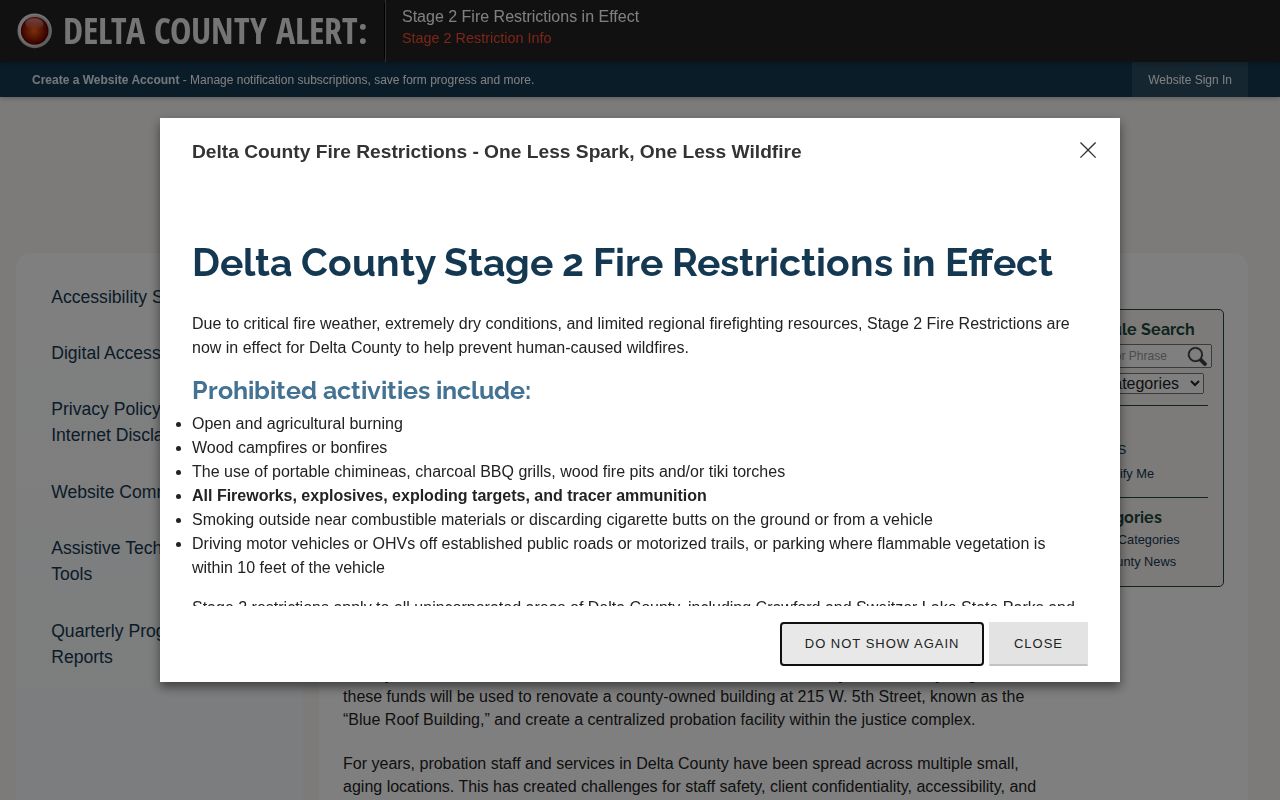
The image supports the page's local supervision context, while the actual verification still runs through court, probation, CDOC, VINE, and records channels.
Delta County Parole Records
For parole, the central state source is the Colorado State Board of Parole. The CDOC offender-search system also links a public parole-board calendar that displays monthly calendars and scheduled hearings. That calendar is a schedule source, not a name-level decision archive.
Parole materials may refer to application interviews, deferrals, grants to discretionary parole, rescission hearings, revocation hearings, full-board review for certain violent-offense referrals, and discharge from parole. These terms describe steps in the state-prison parole process. For a Delta County jail-only case, the court and probation path is usually more relevant.
Note: A parole hearing date can help explain timing, but it does not prove the person has been released.
Delta County Violations and Warrants
A release into supervision is not the same as an unconditional end of the case. Conditions can include reporting, treatment, travel limits, payment orders, court dates, or other requirements set by the court or parole authority. If a person fails to comply, the record may shift to violation, warrant, revocation, or absconder status.
For Delta County probation, start with the local court case and probation office. For state parole, use CDOC status, parole-board materials, and VINE where available. For a person returned to jail after a violation, the jail record and court docket may again become part of the supervision trail.
Delta County Release ID Records
Delta County documented a replacement-photo-ID initiative at the jail. The county reported that Delta County became the first jail in Colorado to offer replacement photo IDs outside DOC facilities and that a Mobile DMV event provided IDs for 12 inmates, which represented 30 percent of the jail population at that event. Identity documents can affect court follow-up, records correction, supervision reporting, and reentry logistics.
Do not confuse an ID program with a release record. It does not prove parole or probation by itself. It is a local release-support fact that may help explain how a person handles lawful tasks after leaving custody.
How Delta County Supervision Ends
Supervision ends when the controlling authority records discharge, completion, termination, or another lawful end status. For probation, that source is tied to the court and Judicial Branch probation. For parole, it is tied to CDOC and the State Board of Parole. A person may be released from jail long before the supervision record is complete.
When the question is broader than supervision, use the home page for the full Delta County released inmate record path. It covers jail release records, court disposition, CDOC offender search, VINE, and federal or immigration transfers in one search workflow.
For probation, the court file may show the order that placed the person under supervision, later violation hearings, warrants, compliance review, or case closure. For parole, the CDOC profile and parole-board materials may show hearing context, supervision status, revocation events, and discharge. Those records answer different questions, so the verification path should follow the release source.
When the record is unclear, start with the case that put the person in custody. Local case, local probation path. State-prison case, CDOC parole path.
If both paths appear, compare dates. A person can have an older probation matter and a newer CDOC record, or a local warrant tied to a parole event. The most recent controlling custody source should guide the next call.
Delta County Supervision Records
Supervision records should be read with the custody history. A person released from the Delta County Detention Facility on a local sentence may have a probation condition, a review hearing, or a violation matter in the court docket. A person released from Delta Correctional Center or another CDOC facility may have parole eligibility, hearing history, discretionary parole, revocation, or discharge information in CDOC and parole-board materials.
The local probation office does not publish a broad public supervision list in the research. That means verification often begins with the court case and then moves to probation contact or records procedures as allowed. Public docket entries may show enough to identify the supervision path, but they may not include detailed conditions. Conditions can be case-specific and may not be public in the same way as docket events.
For parole, the public calendar can show scheduled hearings, but it is not a decision search. A release to parole should be confirmed through CDOC status, VINE when available, and any formal CDOC record if the timing matters. For probation, look to the court order and local Judicial Branch probation route. Keeping those two channels separate is the main rule for Delta County post-release supervision.
A supervision search should also account for timing. Jail release, probation intake, parole release, and discharge may all fall on different dates.